logo
قیمت خوب  آنلاین

جزئیات محصولات

Created with Pixso. خونه Created with Pixso. محصولات Created with Pixso.
Autoclave Aerated Concrete Engineering
Created with Pixso. Intelligent AAC Block Production Line High-Efficiency Autoclaved System

Intelligent AAC Block Production Line High-Efficiency Autoclaved System

نام تجاری: JEFFER
شماره مدل: سفارشی
موق: 1 مجموعه
قیمت: USD1million
زمان تحویل: 30 روز پس از دریافت پیش پرداخت
شرایط پرداخت: L/C، T/T
اطلاعات دقیق
محل منبع:
چین
گواهی:
ISO9001,ISO14001,ISO45001
جزئیات بسته بندی:
جعبه چوبی، سینی، قاب فولادی و غیره
قابلیت ارائه:
1 ست در هر 1 ماه
توضیح محصول

1. Product Highlights 

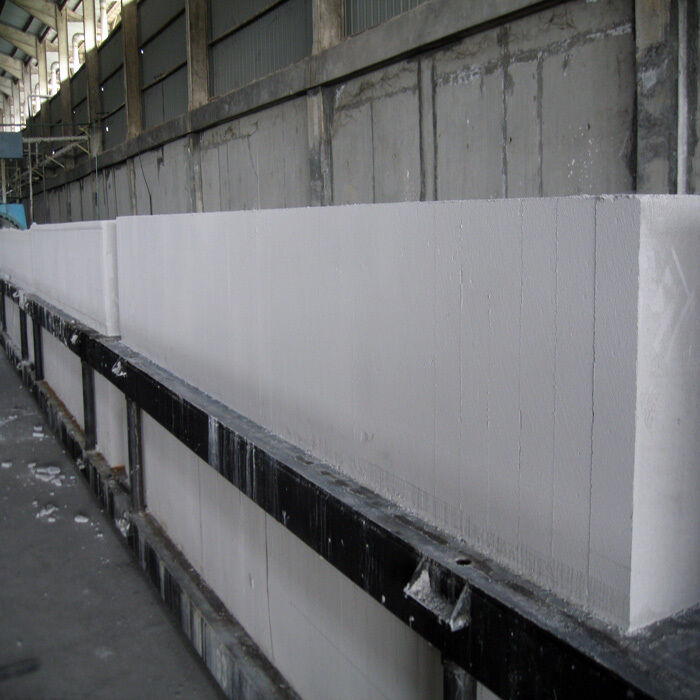
Autoclaved Aerated Concrete (AAC) blocks are a lightweight, cellular, next-generation green building material. They outperform traditional clay bricks across multiple fronts: bulk density is roughly one-third that of conventional masonry, easing structural loads and cutting freight costs; compressive strength meets diverse design specs for both load-bearing and infill walls; the closed-cell pore structure delivers low thermal conductivity, significantly boosting building energy performance; durability is excellent under varied climate conditions; and the material can be sawed, planed, nailed, and anchored on site with ordinary tools, accelerating construction and shortening project cycles. These features make AAC blocks especially suitable for framed structures, high-rise residential towers, seismic zones, and public/commercial buildings with strict energy-efficiency mandates. They are also an ideal infill and enclosure component within prefabricated building systems.

2. Raw Materials & Local Sourcing Advantages

All raw materials for AAC production are widely available and economically priced, with most sourced locally to minimize shipping expenses and supply-chain exposure. The primary ingredients are:

  • Silica sources: fly ash, bottom ash (including boiler slag and industrial residues), or natural quartz sand;

  • Lime: quicklime, which also drives the gas-reaction process;

  • Cement: ordinary Portland cement, for regulating early green-body strength;

  • Gypsum: added in small amounts to tailor setting time and final properties;

  • Aluminum agent: powder or paste, acting as the foaming agent to generate uniform gas bubbles throughout the slurry.

Formulations can be adjusted according to local material availability, ensuring both cost efficiency and reliable long-term supply post-commissioning.

3. Capacity Options & Dimensional Specifications

JEFFER provides customized AAC lines in three capacity ranges, matching different investment levels and market demand:

 
Capacity Class Annual Output (m³) Recommended For
Small Line 20,000 – 50,000 Regional mid/small manufacturers; pilot projects in emerging markets
Medium Line 50,000 – 100,000 Provincial/regional supply centers
Large Line 100,000 – 400,000 Large industrial groups; export-oriented facilities

Standard block dimensions:

  • Length: 600 mm (base module);

  • Width: 200 – 300 mm (adjustable);

  • Thickness: 75 – 250 mm (adjustable);

  • Density: 500, 600, or 700 kg/m³ (customizable per energy-code requirements).

Both size and density can be modified to match client orders and local building standards, ensuring seamless regulatory alignment.

FAQ

Q1: Why choose AAC blocks over clay bricks?

A: AAC blocks offer clear benefits: (1) Much lighter – about one-third the density of clay bricks, reducing foundation needs and transport costs; (2) Better insulation – low thermal conductivity improves energy efficiency; (3) Faster production – autoclave curing enables large-scale continuous output; (4) Eco-friendly – uses industrial waste like fly ash and slag, supporting circular-economy goals; (5) Easier installation – blocks can be cut and shaped on-site, boosting masonry productivity.

Q2: Does JEFFER supply both equipment and installation?

A: Yes. We deliver a full turnkey service – from feasibility studies, mix design, and plant layout, to equipment fabrication, delivery, installation supervision, trial runs, and staff training. You won't need to manage multiple suppliers; we handle full-line integration and guarantee overall performance.

Q3: What utilities are needed to run the line?

A: Basic requirements include: (1) Electricity – for crushers, mills, mixers, cutters, and autoclaves; (2) Steam – for curing (supplied by coal, gas, or biomass boilers); (3) Water – for slurry preparation and replenishment; (4) Compressed air – for controls and certain process steps. Exact consumption figures and utility details will be provided during the feasibility phase, based on your chosen capacity.

Q4: Is after-sales support available?

A: Absolutely. After handover, we offer long-term services: remote troubleshooting, routine site inspections, process optimization advice, and genuine spare parts supply. Our goal is to keep your line running reliably and efficiently throughout its entire lifecycle.

محصولات مرتبط